
The peculiar case of the Cootamundra wattle

Acacia baileyana
Cootamundra wattle
The Cootamundra wattle (Acacia baileyana) is a little strange in that it occurs naturally within a very small range, approximately 50k around the surrounds of Cootamundra in south western New South Wales. However when planted outside its natural range, it does quite well. It has spread to various areas across Australia and overseas.
The Cootamundra wattle is a small tree from 3 to 10 metres high. It is one of those species which retain the fern-like, bipinnate foliage throughout their lives (in most other species, the bipinnate foliage is replaced by flattened stems called phyllodes). The pinnae (the divisions of the pinnate leaves) are up to 30 mm long and silvery-grey in colour. The plant has smooth, greyish brown bark. The bright yellow flower clusters are globular in shape and are produced in the leaf axils in late winter to spring (Australian Native Plant Society).
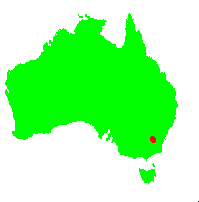
Distribution of Acacia baileyana
Source: Australian Native Plant Society
In some areas, both within Australia and overseas, A. baileyana has spread from garden plantings into surrounding areas and is regarded as an environmental weed. Invasive populations occur in parts of Western Australia, South Australia, Queensland, New South Wales and Victoria. This wattle can also be found in New Zealand, while in South Africa it is classed as a category 3 Declared Invader (World Wide Wattle).
Factors that contribute to the weediness of A. baileyana are its ability to produce high numbers of flowers which result in high seed production. Under appropriate conditions the seedlings establish in large numbers. Fires and mechanical disturbance (which may occur along road verges and power lines, etc.) can increase the spread by stimulating mass germination. The dispersal of plants and seed by people due to its popularity as a garden plants has contributed to the spread of this plant (World Wide Wattle). So if you are planting it in your garden, you need to take care that you don’t live to close to a bushland area.
John Williamson has also written a song about the wattle which can be seen here.